Mother's Day in the United Kingdom
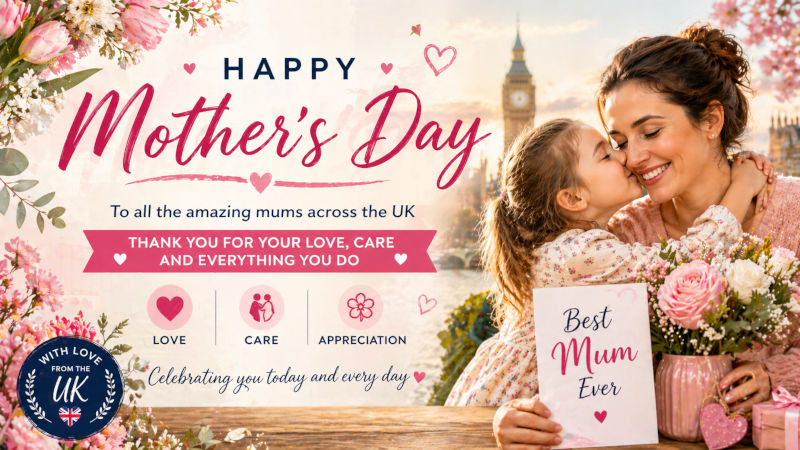
Mother's Day in the United Kingdom is traditionally known as Mothering Sunday. It is celebrated on the fourth Sunday of Lent, which means the date changes every year.
Unlike many countries that follow the American-style Mother's Day in May, the UK has a much older religious and cultural origin tied to the Christian calendar.
Mother's Day - Dates
This year (2026)
| Name | Date | Holiday Type | Countries | |
|---|---|---|---|---|
| Mother's Day | Sunday, 15 Mar 2026 | Observance | All |  |
Next year (2027)
| Name | Date | Holiday Type | Countries | |
|---|---|---|---|---|
| Mother's Day | Sunday, 7 Mar 2027 | Observance | All | |
Last year (2025)
| Name | Date | Holiday Type | Countries | |
|---|---|---|---|---|
| Mother's Day | Sunday, 30 Mar 2025 | Observance | All | |
This makes the UK version of Mother's Day one of the earliest celebrated globally each year.
What is Mothering Sunday?
Mothering Sunday originated in the Middle Ages as a religious tradition when people would return to their "mother church" - the main church in their area.
Over time, it evolved into a day when domestic servants were given a day off to visit their families, especially their mothers.
Eventually, it transformed into a celebration of mothers themselves, blending religious, cultural, and family traditions.
Modern Mother's Day in the UK
Today, Mother's Day in the UK is largely focused on appreciation, gifts, and family time, similar to other countries.
However, it still retains a more traditional and sentimental tone compared to purely commercial celebrations.
Why Mother's Day Matters
Mother's Day reflects both emotional and social value in British society.
According to Office for National Statistics (ONS) research:
- Women still perform a higher share of unpaid childcare and household work
- Family caregiving remains a major part of informal social support systems
This highlights why recognition of mothers continues to be socially important.
How Mother's Day is Celebrated in the UK
1. Flowers and Cards
One of the most common traditions is giving flowers, especially:
- Daffodils (popular in spring)
- Roses
- Tulips
Handwritten cards remain highly valued in the UK culture.
2. Family Meals
Many families celebrate with Sunday lunch or afternoon tea.
Pubs and restaurants often offer special Mother's Day menus.
3. Homemade Gestures
Unlike heavily commercial holidays, many Brits still prefer:
- Cooking for their mother
- Cleaning or helping at home
- Spending quality time together
4. Church Services (Traditional Element)
Some families still attend church services, reflecting the religious origin of Mothering Sunday.
Interesting Facts
- Simnel cake tradition: A light fruit cake with marzipan, historically associated with Mothering Sunday
- Religious roots still visible: Some churches distribute daffodils or blessings for mothers
- Victorian revival: The modern version of Mothering Sunday was revived in the early 20th century
- Seasonal connection: Daffodils play a symbolic role because they bloom around March in the UK
Travel Tips for Visitors in the UK
- Book restaurants early - they get fully reserved quickly
- Expect busy brunch and afternoon tea venues
- Public transport may be busier in cities
Mothering Sunday is widely observed across the UK, especially in England, Wales, and Northern Ireland.
Frequently Asked Questions
When is Mother's Day in the UK?
It is celebrated on the fourth Sunday of Lent each year.
Is Mother's Day the same as Mothering Sunday?
Yes, in the UK it is traditionally called Mothering Sunday.
What are popular Mother's Day gifts?
Flowers, chocolates, greeting cards, and family meals are common.
Why is it celebrated in March in the UK?
It is tied to the Christian calendar of Lent, not a fixed date in May.